
A PRACTICAL PLANNING GUIDE
How to compare the time and money needed for a career change.
Compare a possible week and a possible budget together. This worked example shows what changes when a professional reduces working hours to make more room for study—and what the numbers cannot tell you.
1. Define the decision and the period.
Imagine a professional considering a six-month learning period. One option is to keep full-time work and study in the evenings and at weekends. Another is to agree reduced working hours and use some of the released time to study.
The decision is whether the second option creates enough useful study time to justify its financial trade-off. Six months is an illustrative comparison period, not a prediction of when someone will qualify or find a job. Check actual course requirements and employment terms separately.
Write down what you want to protect: essential bills, family commitments, recovery time, or another priority. Those boundaries make the comparison useful even before you choose an option.
2. Write down what is already committed.
Start with your current week and budget. Include paid work, commuting, study, care duties, appointments, sleep and recovery. A block cannot be available for study and another commitment at the same time.
For money, separate net income, recurring living costs, course fees, one-off purchases and irregular expenses. Note which numbers come from an agreement or bill and which are estimates. If an expense is already included in living costs, do not add it again.
Our example assumes net income is already after relevant deductions. It does not calculate a salary from working hours or estimate taxes. The two income figures are independent fictional inputs.
3. Put the alternatives side by side.
| Input or result | Full-time work plus study | Reduced work plus study |
|---|---|---|
| Work hours / week | 40 | 32 |
| Study hours / week | 6 | 12 |
| Net income / month | EUR 3,000 | EUR 2,400 |
| Living costs / month | EUR 2,000 | EUR 2,000 |
| Course costs / month | EUR 200 | EUR 200 |
| Remaining / month | EUR 800 | EUR 200 |
| Remaining over six months | EUR 4,800 | EUR 1,200 |
Remaining means income minus the two listed costs. It is not a complete savings forecast. The six-month totals assume every monthly input remains unchanged and do not include an opening balance.
4. Check where the study time actually fits.
For six study hours, try two 90-minute weekday sessions and a three-hour Saturday session. Check that these fit around the rest of a Sunday–Saturday week. This example accounts for selected commitments, not all 168 hours.
In the reduced-work option, work falls by eight hours while study rises by six. Two hours remain within those selected categories. That is not proof of two hours of overall free time: travel, care, rest and other changes may use them.
Ask which released hours are usable for focused learning. A free hour between two commitments may not serve the same purpose as a longer uninterrupted session. More scheduled study also does not guarantee faster progress.
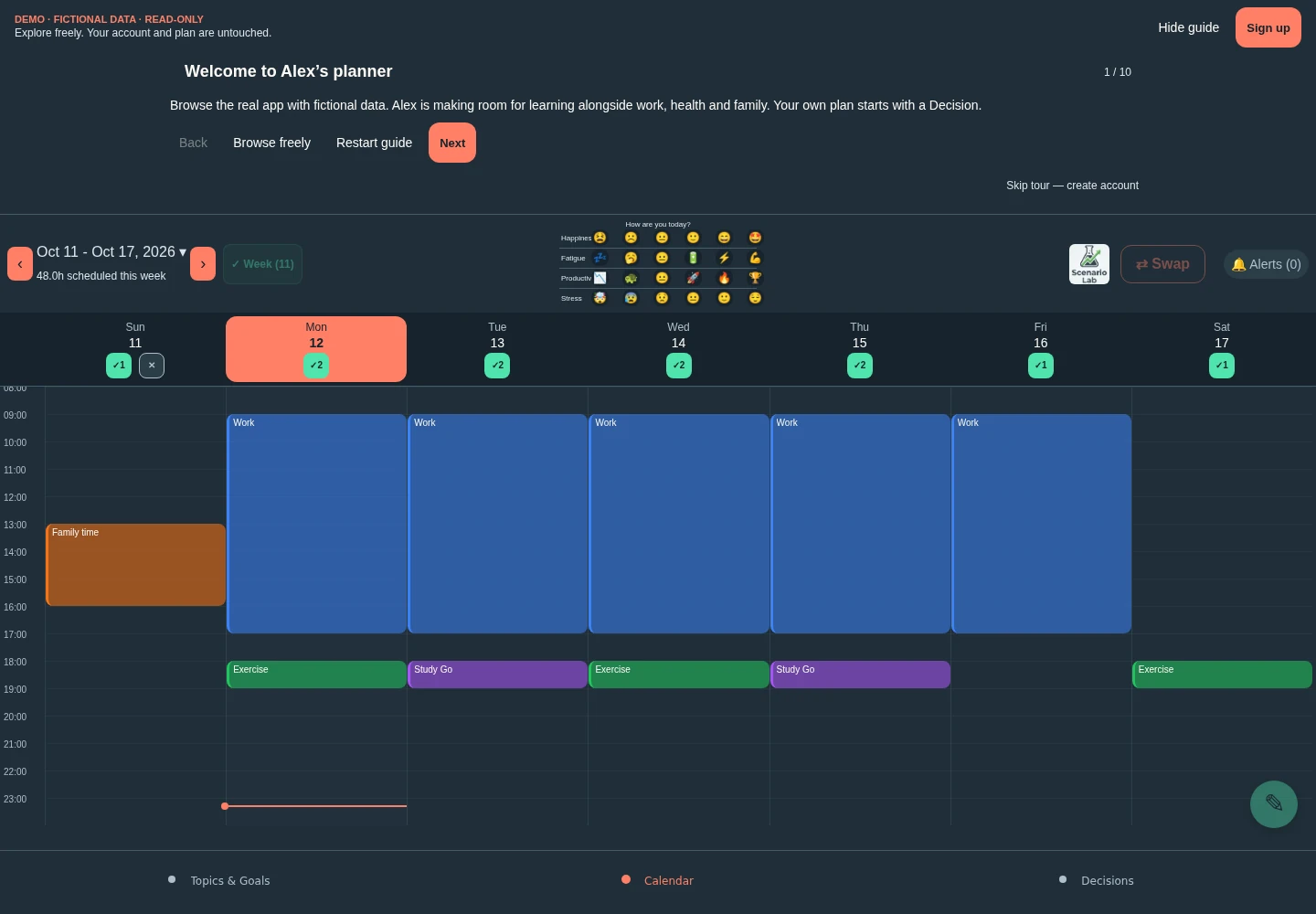
The weekly planning ritual helps you review the difference between a possible week and a week you can repeat.
5. Calculate the difference, then change an assumption.
With full-time work, EUR 3,000 − EUR 2,000 − EUR 200 leaves EUR 800 a month. With reduced work, EUR 2,400 − EUR 2,000 − EUR 200 leaves EUR 200. The difference is EUR 600 a month, or EUR 3,600 across six unchanged months.
Now increase monthly living costs by EUR 300. The remainders become EUR 500 and minus EUR 100 respectively. A negative amount means these listed costs exceed that month's assumed income; it does not by itself tell you whether a plan is affordable over time.
Repeat the comparison with assumptions that matter to your decision: a different course fee, fewer available study hours or a delay in changing work arrangements. Do not treat the example's recurring EUR 200 course cost as the billing schedule of any real course.
Before using a remainder to make a decision, account for omitted costs and balances. This example excludes opening savings, debt payments not already included, irregular expenses, taxes not captured in net income, investment returns, inflation and future employment outcomes. It does not recommend a savings target, borrowing decision or investment strategy.
6. Explore the alternatives in LifeProjection.
- Describe the current plan. Use your goals, calendar commitments and financial inputs to record assumptions you can explain.
- Explore a supported alternative. Use Scenario Lab to compare planning changes against the baseline.
- Inspect what changed. Review the time and financial implications, and check which changes the app supports applying.
- Choose and revisit. Apply only the supported changes you choose. Review the plan as your commitments and information change.
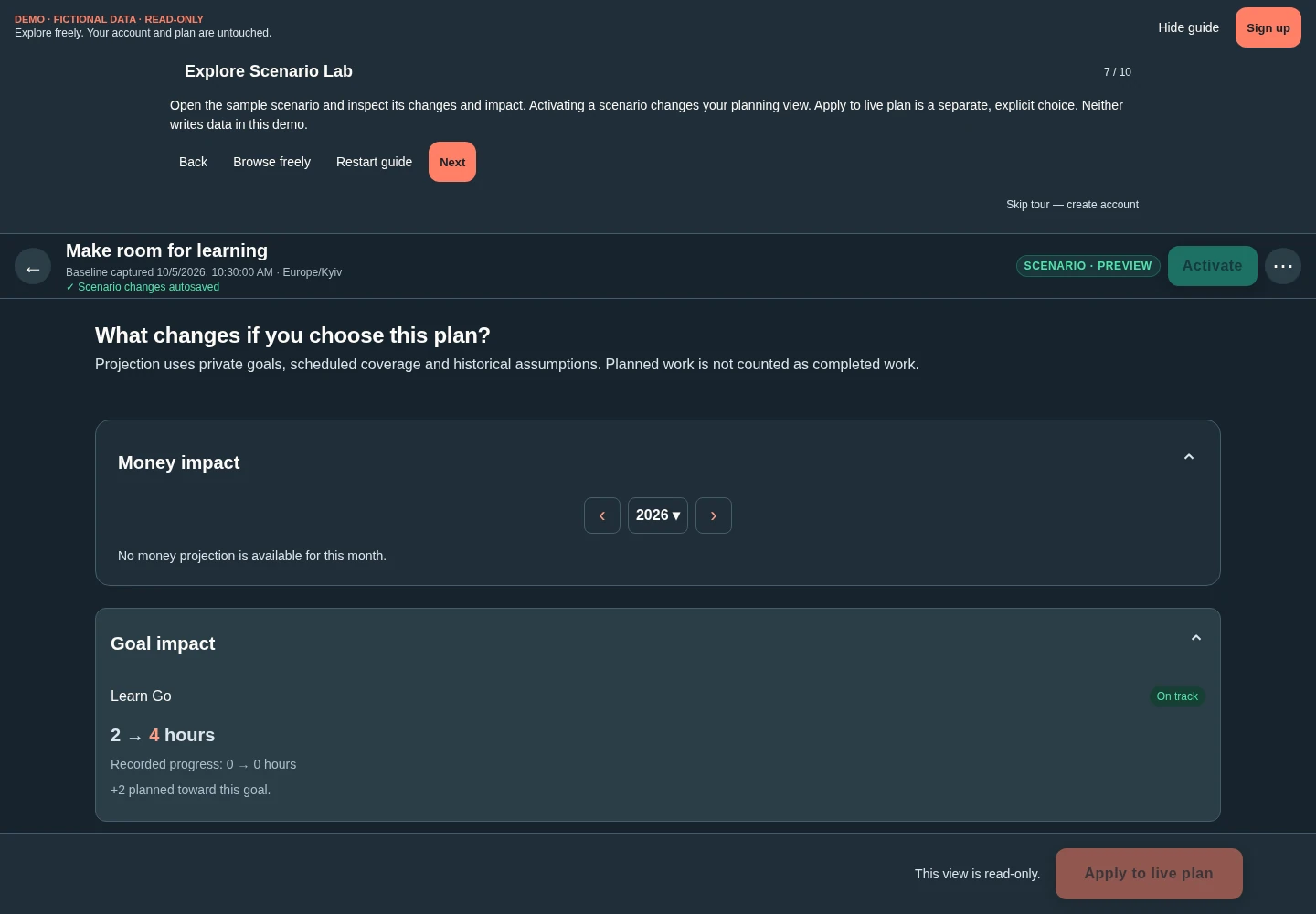
Do not assume that every app setting is isolated in a scenario or that every change can be applied. Read the available review before acting. A projection explains the consequences of entered assumptions; it cannot guarantee an outcome.
7. A checklist before you choose.
- Which assumptions are confirmed, and which still need checking?
- Where do study blocks fit without double-booking other commitments?
- Have you included course, travel, care and irregular costs where relevant?
- What happens if income is lower, costs are higher or the course takes longer?
- Which changes can you reverse, and which require agreement with someone else?
- When will you revisit the comparison using what you have learned?
For a shorter introduction, see the career-change example. For the day-to-day scheduling problem, see studying alongside work. About LifeProjection explains who makes the product and how to contact the creator.
Explore a possible plan.
Try the app with fictional data, or create an account for your own commitments and assumptions.